
How to Backup Google Photos Without Google Takeout (After rclone Lost Access)
· 6 min read · Updated
If you have 10,000 or 50,000 photos in Google Photos and you want them on your computer, Google gives you two options:
- Select photos by hand in the web interface. You can select up to 500 at a time, click download and receive a zip file, then repeat until you have covered your whole library.
- Use Google Takeout to request an export of your entire library. Google prepares zip archives and emails you a download link, which can take hours or even days depending on library size.
Neither option lets you browse your library, pick a destination and transfer everything in one step. Neither one syncs, resumes, or sends files directly to another cloud provider.
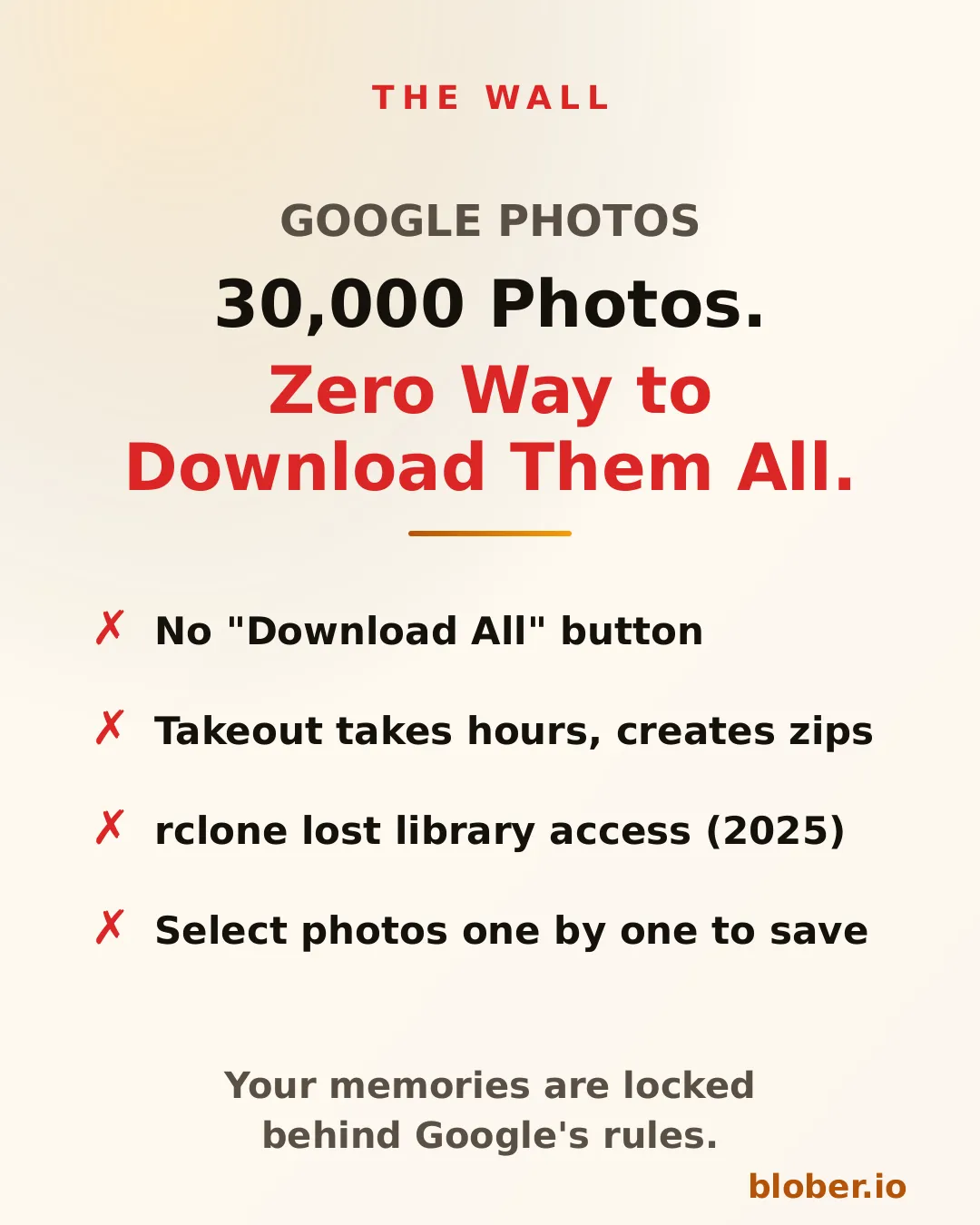
Google Takeout is the official way to export a Google Photos library. It works on paper, but in practice it has real limits:
- Google creates your archive in the background, and for large libraries that can take 12 to 48 hours.
- Your photos arrive in multiple zip archives, often split into 2 GB chunks, and you have to download and extract each one.
- There is no folder structure: Takeout puts all photos into flat directories organized by date. If you had albums, their names may only appear in metadata JSON files next to the images. See how to download Google Photos without JSON files for what they hold and when you need them.
- If a download fails, you start over. There is no resume and no incremental sync.
- Takeout can deliver the archive to Google Drive, Dropbox, OneDrive or Box[1], but it arrives as zip or tgz files you still have to unpack. Backblaze or a NAS means downloading it through your browser first.
For someone with 200 GB of family photos, Google Takeout means hours of waiting followed by hours of downloading and extracting.
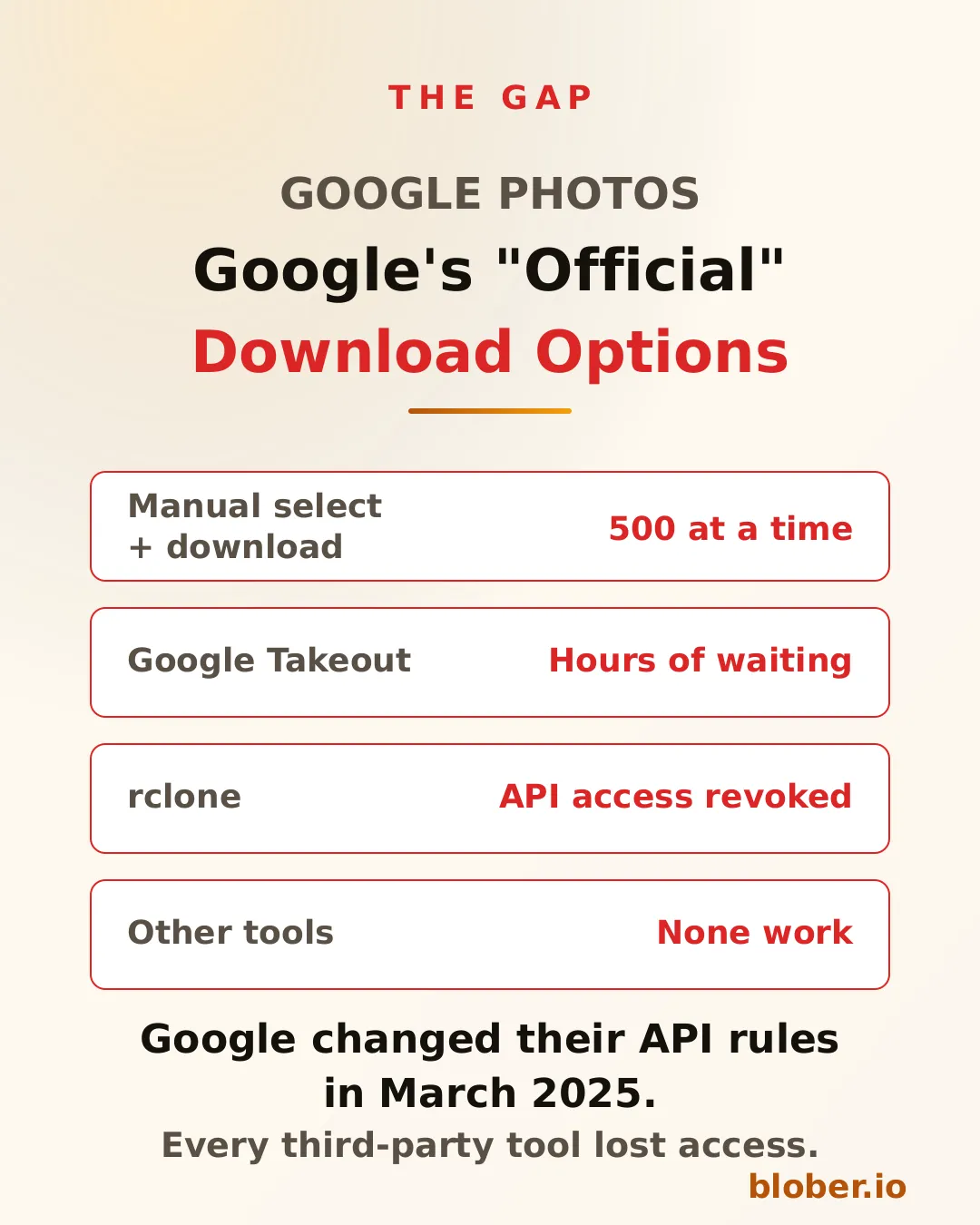
Until early 2025, rclone had a Google Photos backend that could list and download your photo library. Then Google changed its API access policy.
Starting March 31, 2025, rclone can only download photos that were uploaded through the rclone API itself. If you uploaded your photos through the Google Photos app, the web interface or any other method, rclone cannot access them anymore. The rclone documentation says so directly: "From March 31, 2025 rclone can only download photos it uploaded."
So rclone no longer works for backing up or migrating an existing Google Photos library. Other transfer tools like MultCloud, Flexify and various CLI utilities face the same restriction or never supported Google Photos at all.
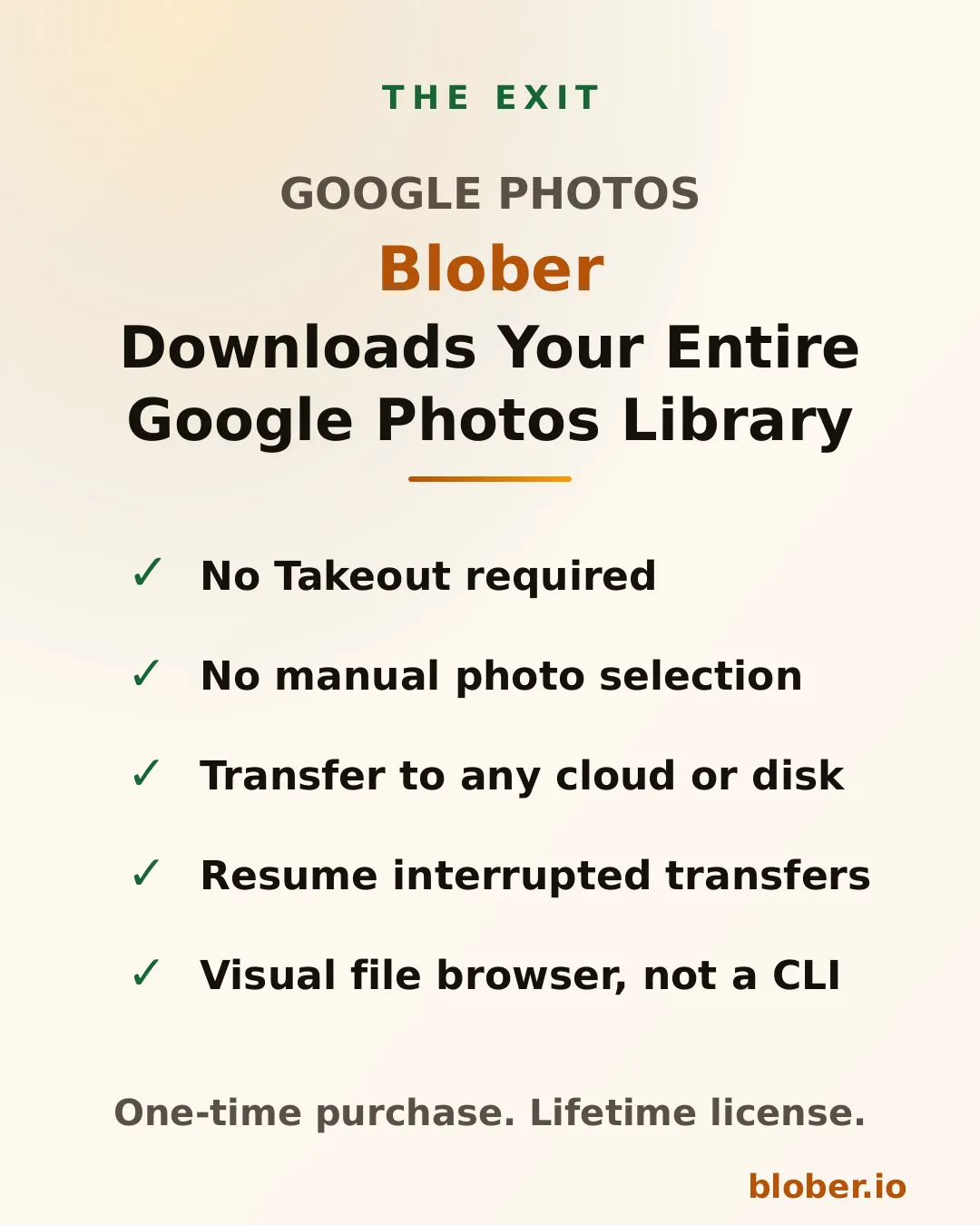
Blober is a desktop application for Mac, Windows and Linux that connects to Google Photos and shows your entire library in a visual file browser, with no command line to configure. From there, you can:
- Download all photos and videos to your local disk, an external drive or a NAS
- Transfer the library to Dropbox, Google Drive, Backblaze B2, AWS S3 or any other supported provider
- Browse the library by date, or as one flat list, in a file manager view
- Resume interrupted transfers automatically if your connection drops
- Replace files that already exist at the destination by setting destination deduplication to Overwrite the existing file (by default they are skipped)
You connect your Google Photos account, pick a destination and start the transfer, without Takeout, zip files or selecting photos by hand.
| Feature | Google Takeout | Blober |
|---|---|---|
| Bulk download | Yes, after hours of waiting | Yes, immediate |
| Folder structure | Flat zip archives | Date folders (YYYY-MM-DD), or year and month folders with a path template; albums are not recreated |
| Resume on failure | No | Yes, automatic |
| Transfer to another cloud | Archives only, to Drive, Dropbox, OneDrive or Box | Yes, to any supported provider |
| Real-time browsing | No | Yes, visual file browser |
| Skip files already downloaded | No | Re-runs into a local drive or NAS can skip already-downloaded files |
For repeat exports, see how task resume and destination deduplication prevent duplicate downloads. Resume an interrupted task to keep its per-file progress. When you deliberately start a new export into the same folder, the destination skips files whose name already exists there by default, and you can switch it to overwrite them instead.
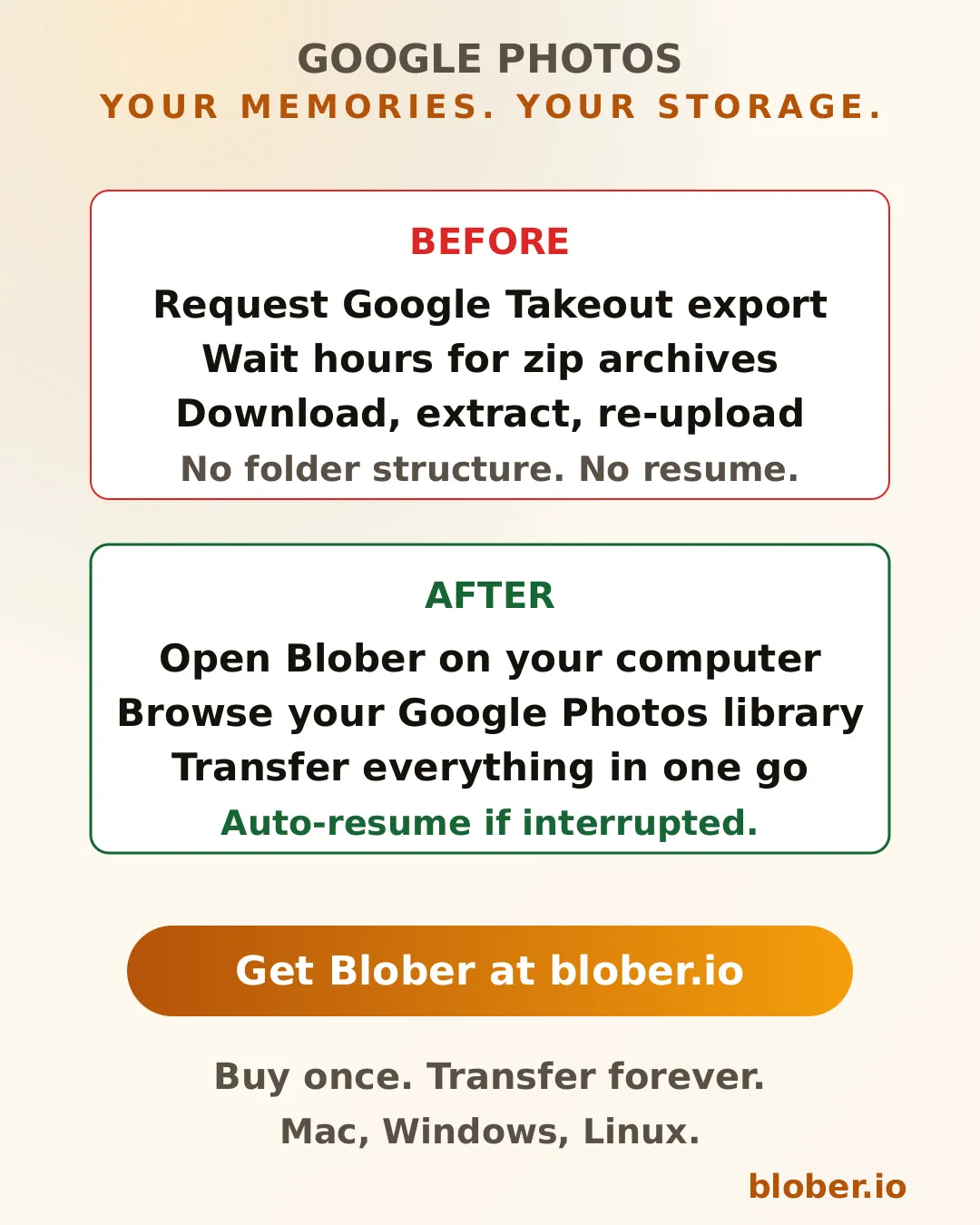
Connect Google Photos in Blober, select your local disk as the destination, and transfer. Every photo and video downloads to a folder on your computer, and a 100 GB library transfers without zip files or extraction.
If you are leaving Google Photos for another service, Blober transfers your library directly. Connect Google Photos as the source and Dropbox as the destination. The photos stream through your computer on their way from one cloud to the other, so you don't need a local copy, though you can make one.
Pair Google Photos with Backblaze B2 in Blober, and your whole photo library is copied to B2, where storage costs $6.95/TB/month. That gives you an independent backup that does not depend on Google.
Google Photos is not a backup. Google can change its terms, adjust its storage pricing or restrict access at any time, and the March 2025 API change showed it: tools that worked for years stopped working overnight.
A local copy of your photos, or a copy with a second cloud provider, means you do not depend on a single company to reach your own memories.
- Anyone with a large Google Photos library who wants a local backup
- People leaving Google Photos for Dropbox, iCloud or another service
- Parents and families with years of photos who want a second copy on a hard drive
- Photographers who used Google Photos as a sync target and need to migrate
- Privacy-conscious users who want their photos on storage they control
Can I download all my Google Photos at once? Not from the Google Photos website, which lets you select up to 500 at a time. Google Takeout exports the whole library as zip archives, and Blober downloads it without Takeout.
Does rclone still work with Google Photos? Only for photos rclone uploaded itself. Since March 31, 2025, it cannot download photos you added through the Google Photos app, the web interface or other tools.
How long does Google Takeout take? For a large library, Google can take 12 to 48 hours to create the archive. It then arrives as several zip files, often split into 2 GB parts, that you download and extract.
Can I run the backup again later for new photos? Yes. Run the workflow again into the same folder. With the default deduplication setting, files whose name already exists there are skipped, so only the new photos download.