How to Move Google Photos to Proton Drive (Without Google Takeout)
Google Photos to Proton Drive: Two Very Different Paths
Section titled "Google Photos to Proton Drive: Two Very Different Paths"Google has no "download all" button, and every official route for moving your library out is slow and manual. If you are switching to Proton Drive for privacy, you have two practical paths.
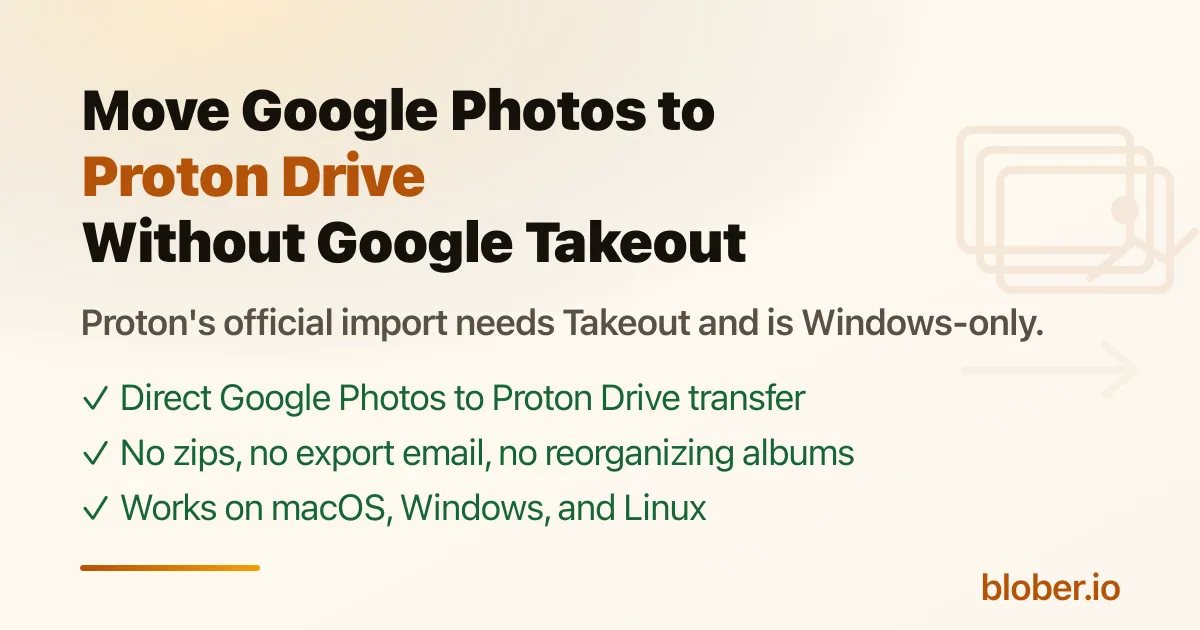
Proton's official way exports your whole library through Google Takeout, then imports it into Proton Drive; the desktop import is Windows-only. Blober connects to Google Photos directly and transfers your photos to Proton Drive without Takeout, on any platform. This guide walks through both with the trade-offs, so you can pick the one that fits your library.
Path 1: Proton's Official Way (Google Takeout)
Section titled "Path 1: Proton's Official Way (Google Takeout)"Proton's official guide, "How to import from Google Photos into Proton Drive"[1], has three steps:
- Export your Google Photos. Sign in at takeout.google.com, select Google Photos, and create an export. Google prepares the archive in the background and emails you a download link, which is valid for one week.
- Download your export. Download all parts, then unzip them.
- Import into Proton Drive. Either drag the unzipped folders into the Photos tab in the web app, or use the Windows desktop app: Photos import, then Import from Google Photos.
Proton's own documentation flags the rough edges:
- It is Windows-only for the desktop import. The feature announcement says "Google Photos import now supported on Drive for Windows" and notes "Photo import support for macOS is coming soon"[2].
- Takeout scatters albums. "Google Takeout splits large exports into multiple parts, but it may not keep photos from the same year in the same part... This can cause issues if you're using Proton Drive's desktop app, which builds albums based on folder structure"[3]. Proton's advice is to manually reorganize photos into year folders before importing.
For a small library, this path works. For tens of thousands of photos, it is a multi-day chore: wait for the export, download zips, extract, reorganize, then upload.
Path 2: Blober (Direct Google Photos to Proton Drive)
Section titled "Path 2: Blober (Direct Google Photos to Proton Drive)"Blober is a desktop app that connects to Google Photos and to Proton Drive as two endpoints, then transfers the photos you select between them.
- Connect Google Photos in Blober (you see your whole library in a file browser).
- Connect Proton Drive (a browser window opens to Proton's own login page; your password never touches Blober).
- Select the photos you want and start the transfer.
Google Photos Is Flat - and So Is Proton Photos
Section titled "Google Photos Is Flat - and So Is Proton Photos"Google Photos has no folders. When you browse your library in Blober, the date-based view you see (for example 2026-08-23/IMG...) is a virtual grouping Blober builds so you can find photos by when they were taken - nothing is moving between real Google folders. There is no source folder tree to preserve.
Where your photos land in Proton then depends on which surface you choose as the destination:
- A folder in Proton Drive (My Files) - for example the root or a
Google Photosfolder. My Files is a normal folder tree, so Blober'sYYYY-MM-DD/{filename}organization creates real date folders here. - The Proton Photos surface (the timeline). Proton Photos is flat: it has no folders, only a date timeline plus albums. A
YYYY-MM-DD/{filename}template cannot create folders on this surface, so every photo is uploaded flat into the timeline and sorted by its capture date instead. In Blober's preview the destination shows asPhotos/{filename}, which reflects that. Google Photos albums are not recreated on either surface.
Pick My Files if you want a real date-folder structure. Pick Proton Photos if you want the timeline and albums. You can also move between the two later - see How to Move Photos from My Files to Proton Photos.
The differences from Takeout:
| Google Takeout + Proton import | Blober | |
|---|---|---|
| Export wait | Hours to days for the archive email | None |
| Zips and unzipping | Yes, often 2 GB parts | No |
| Album structure | Can scatter photos across folders; manual reorganizing advised | Google Photos albums are not recreated. YYYY-MM-DD folders are created when the destination is a Proton Drive (My Files) folder; the Proton Photos surface is a flat timeline and has no folders |
| Platform | Desktop import is Windows-only; web is drag-and-drop | macOS, Windows, Linux |
| Resume on failure | No | Yes, per-file progress with automatic retry |
| Direct to Proton | Requires local download and re-upload | Streams directly to Proton Drive |
| Disk space | Needs free local disk for the whole library | Streams through memory, no full copy staged |
Why Skip Takeout for Large Libraries
Section titled "Why Skip Takeout for Large Libraries"Takeout is designed for backup, not migration. Its pain points are well documented in the community: the export can take a day or more, downloads split into 2 GB zips, there is no resume, and album metadata often lands in separate JSON files instead of real folders. People build entire tools to work around it. A developer who migrated 354 GB wrote up the script he built, "gphoto2proton," precisely because the official flows are so manual[4].
Blober removes those steps entirely: no export request, no zips, no reorganizing. It reads the library in place and writes it straight to Proton Drive.
Migration Tips
Section titled "Migration Tips"- Check your Proton storage first. The free plan is 5 GB. A large photo library needs Drive Plus (200 GB), Unlimited (500 GB), or Duo (2 TB)[5].
- Keep originals until the transfer finishes. Verify a sample of photos in Proton Drive before deleting anything from Google Photos. Proton's own post-migration advice is to remove them from Google Photos only after they are safely stored[6].
- Re-run for new photos. You can run the workflow again later to catch photos added since the last transfer. An interrupted run can be resumed from where it stopped.
- HEIC and RAW files transfer as-is. Blober copies the original files, so formats and EXIF metadata are preserved.
Frequently Asked Questions
Section titled "Frequently Asked Questions"Can Proton Drive replace Google Photos? For private, encrypted photo storage, yes. Proton Drive has automatic mobile photo backup, albums, favorites, filters, and a timeline[7]. It does not have Google's face recognition or unlimited free compression. The move is the hard part, which is what this guide covers.
Can I transfer all of my Google Photos to a hard drive? Yes. Connect Google Photos as the source in Blober and select your local disk as the destination. Blober downloads the whole library without Takeout, and re-runs can skip files that are already on the drive. See the related guide on backing up Google Photos below.
Does Blober use Google Takeout? No. Blober connects to Google Photos directly and transfers photos from the library, so there is no export request, no zip files, and no waiting for an email link. This is the key difference from Proton's official import flow.
Is Proton's Google Photos import available on macOS? Not yet. Proton's desktop import feature is Windows-only as of 2026, with macOS "coming soon"[8]. Blober runs on macOS, Windows, and Linux.
Will my albums be preserved when moving to Proton Drive?
With Takeout, album structure can be scattered across folders, and Proton advises manually reorganizing by year to get clean albums[9]. With Blober, Google Photos albums are not recreated. Each photo lands in a YYYY-MM-DD folder when the destination is a Proton Drive (My Files) folder; if the destination is the Proton Photos surface, photos land flat in the timeline because Proton Photos has no folders - only a timeline and albums.
How do I move Google Drive files (not photos) to Proton Drive? Proton offers a manual import guide for Google Drive files that uses drag-and-drop[10]. Blober also handles Google Drive to Proton Drive transfers directly, alongside photos. See Migrating To or From Proton Drive.