Transferring files between cloud providers today means monthly subscriptions, surprise transfer fees, and wrestling with CLI config files. Most tools are either expensive SaaS platforms or developer-only terminals with steep learning curves.
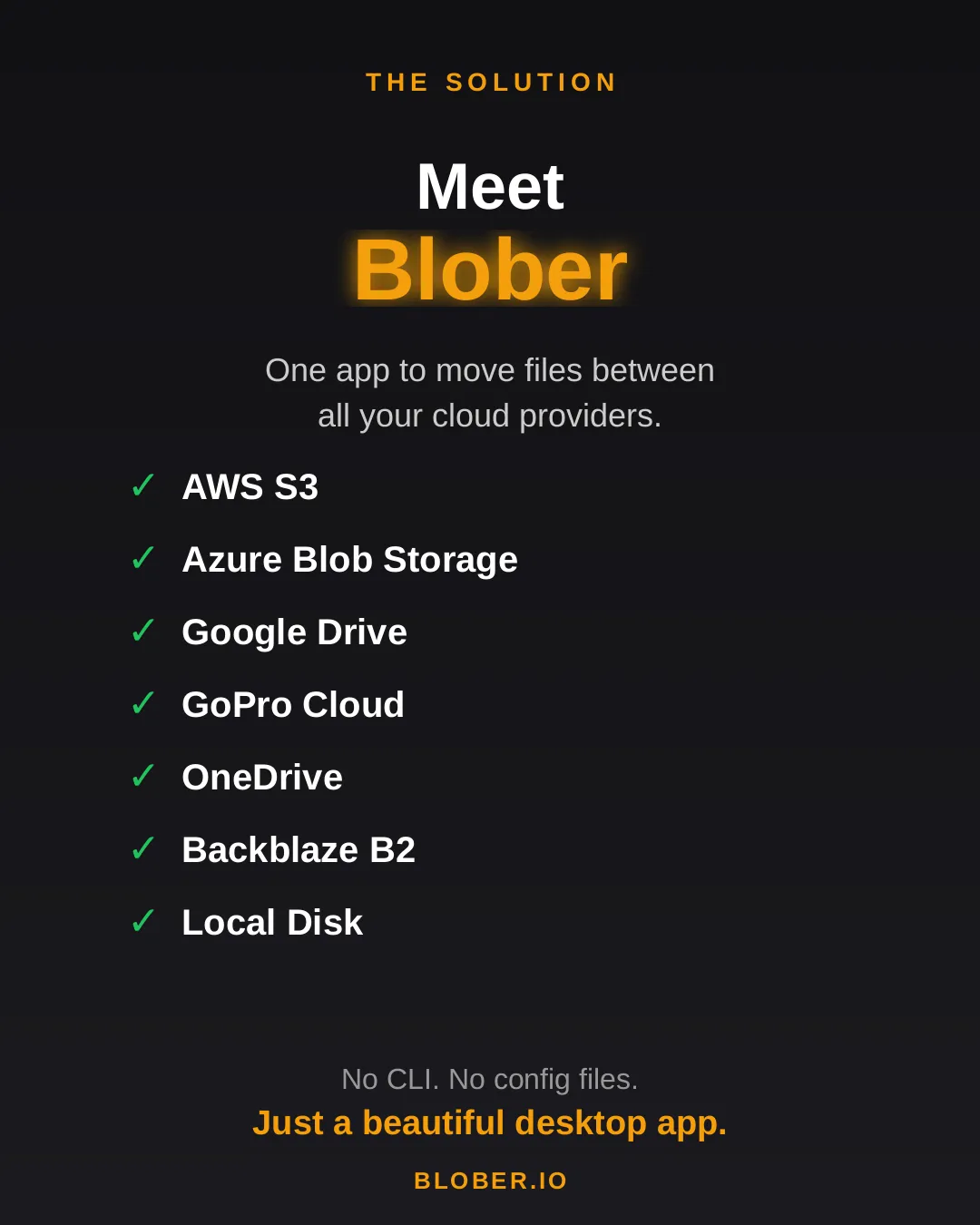
Blober is a desktop app that connects all your cloud storage in one place. AWS S3, Azure Blob Storage, Google Drive, GoPro Cloud, OneDrive, Backblaze B2, and local disk — all supported out of the box. No CLI. No config files. Just a beautiful, intuitive interface.
GoPro’s cloud storage (GoPro Plus / GoPro Premium) offers unlimited storage for GoPro camera media. It’s a great perk - until you want your footage somewhere else.
The reality for most GoPro users:
Painfully limited batch download - GoPro’s web portal caps batch downloads at 25 files at a time, bundled into a ZIP. Large batches frequently fail or time out, and metadata like GPS data may be stripped during compression
No third-party tool support - rclone, MultCloud, Flexify, and every other transfer tool do not support GoPro Cloud
Subscription dependency - cancel GoPro Plus and your cloud access disappears. Your footage remains hostage to a recurring charge
No “Download All” option - if you have hundreds or thousands of files, you’re stuck doing dozens of 25-file batch downloads manually, hoping none fail
GoPro community forums are filled with users asking the same question: “How do I download all my GoPro Cloud content at once?” - and the practical answer is: not without hours of manual work and frequent failures.
Blober is the only desktop application that integrates with GoPro’s cloud storage. No other migration tool - free or paid - supports GoPro Cloud as a source or destination.
With Blober, you can:
Browse all your GoPro Cloud media - photos and videos, organized by date, camera, and type
Download everything at once to your local drive, NAS, or external HDD
Transfer directly to Backblaze B2, AWS S3, Wasabi, Cloudflare R2, Azure Blob Storage, or DigitalOcean Spaces
Use metadata-based path templates to auto-organize files (e.g., by camera model, capture date, resolution)
Resume interrupted transfers - no need to start over if your connection drops
GoPro Plus costs ~$49.99/year. As long as you pay, your footage stays accessible. The moment you cancel, your cloud media goes offline. For years of footage, that’s a dangerous bet on a single subscription.
GoPro Cloud is your only copy in the cloud. There is no built-in backup, no versioning, no geographic replication. If GoPro ever changes their terms, shuts down the service, or experiences data loss - your footage is gone.
Your GoPro footage is yours. Keeping it locked behind a single provider’s subscription model is not ownership - it’s rental. Backing it up to storage you control gives you true data sovereignty.
Can I upload to GoPro Cloud with Blober?
Yes. Blober supports uploads to GoPro Cloud (up to 5 TB per file) with multipart upload and progress tracking.
Does Blober store my GoPro credentials?
No. Blober uses a browser-based login flow. Your session lasts approximately 20 hours, after which Blober prompts you to sign in again. Credentials are never stored or transmitted to any server.
Can rclone, MultCloud, or Flexify do this?
No. As of February 2026, Blober is the only transfer tool that supports GoPro Cloud. rclone (70+ providers), MultCloud (30+ services), and Flexify (~25 clouds) do not include GoPro Cloud integration.
What if my transfer is interrupted?
Blober saves progress and resumes from the last successfully transferred file. No need to re-download everything.
Your footage is irreplaceable - years of adventures, events, and memories sitting in a cloud you can only access through a subscription. Blober gives you a way out: move it all to storage you own and control, in the highest quality, organized exactly how you want.
Photographers and videographers generate enormous volumes of data. A single shoot can produce hundreds of gigabytes of RAW photos and 4K/5.3K video files. Over months and years, that adds up to terabytes of irreplaceable media scattered across local drives, cloud providers, and camera-specific platforms.
The challenges are consistent:
Files are large - 4K video clips are often 1–5 GB each. 5.3K GoPro footage is even larger.
Storage is fragmented - footage lives on local SSDs, NAS devices, Google Drive, GoPro Cloud, and various object storage providers
Organization is painful - manually sorting files into date/camera/project folders is tedious and error-prone
Backups are inconsistent - some footage has 3 copies, some has 1, some has none
Cloud costs add up - Google Drive, AWS S3, and iCloud storage bills grow every month
Most creators have files spread across multiple providers - intentionally or not. Blober connects to all of them in one interface:
Provider
Use Case
GoPro Cloud
Action camera footage auto-uploaded
Google Drive
Client deliverables and sharing
Local NAS / SSD
Primary working storage
Backblaze B2
Long-term archive (cheap, reliable)
Wasabi
Hot archive (no egress fees)
AWS S3
Production infrastructure
Cloudflare R2
CDN-adjacent delivery
Instead of logging into 4 different dashboards and downloading/uploading manually, Blober lets you build workflows that move files between any of these in a single operation.
If you shoot with GoPro cameras, you likely have footage auto-uploaded to GoPro Cloud. The problem: GoPro’s web portal only allows batch downloads of 25 files at a time (as ZIPs that frequently fail), and no third-party tool supports GoPro Cloud as a transfer source.
Blober is the only tool that connects to GoPro Cloud. You can:
Download all GoPro footage to local storage
Transfer directly to Backblaze B2 or Wasabi for long-term archival
Organize files by camera model, date, and resolution automatically
No other tool - not rclone, not MultCloud, not Flexify - supports GoPro Cloud.
Blober’s path templating system uses file metadata to automatically organize transfers. Instead of dumping files into flat folders, you define a template:
/{camera_model}/{capture_date}/{filename}
And Blober organizes the output:
/HERO13 Black/2026-01-23/GX015742.MP4
/Sony A7IV/2026-01-20/DSC09845.ARW
/DJI Mini 4/2026-01-18/DJI_0042.MP4
This works across all providers - GoPro Cloud to local, Google Drive to B2, or any combination. Months of manual folder sorting, automated in one workflow.
For long-term storage, the hyperscalers (AWS, Azure, GCS) are expensive. Creative professionals are increasingly moving to budget-friendly alternatives:
Provider
Storage Cost
Egress
Why Creators Choose It
Backblaze B2
$6/TB/month
Free (up to 3x)
Cheapest reliable archive
Wasabi
$6.99/TB/month
Free
No egress fees, predictable billing
Cloudflare R2
$15/TB/month
Free
Zero egress, great for delivery
Blober supports all of these, making it trivial to set up an archive workflow: shoot → ingest to local NAS → archive to Backblaze B2 → done. One-time license, no per-GB fees.
After each wedding: 80 GB of RAW photos + 40 GB of video. Create a Blober workflow that copies everything from your SSD to Backblaze B2, organized by date and event name. Run it after every wedding with one click.
Finished projects sit on Google Drive eating into your 2 TB plan. Use Blober to move completed projects to Wasabi for long-term storage at a fraction of the cost, freeing up Google Drive space for active work.
Years of GoPro footage sitting in GoPro Cloud with no easy way out. Use Blober to download everything to a local NAS, organized by camera and date. Cancel GoPro Plus knowing your footage is safe.
100+ GB per flight day across DJI footage on local cards and backup copies on Google Drive. Use Blober to standardize your archive: everything goes to Backblaze B2, organized by date and location, with a local NAS mirror.
rclone is free and powerful, but it requires terminal expertise. For each new storage provider, you configure a remote. For each workflow, you write a command with precise flags. There’s no visual interface, no persistent workflows, and no GoPro support.
If you’re a software engineer, rclone might work. If you’re a photographer who wants to focus on photography, Blober is what you need.
Blober is available for Windows, macOS, and Linux. One-time license, currently at discounted beta pricing. No subscriptions. No per-GB fees. No data caps.
Connect your providers, build your workflows, and take control of your media archive.