Data Holders: How Blober Fits Your Workflow
Who Are Data Holders?
Section titled “Who Are Data Holders?”Data holders are individuals and organizations that accumulate, manage, and preserve large volumes of digital files as a core part of their work. They aren’t just storing files — they’re responsible for keeping data accessible, organized, and safe across years and even decades.
Data holders include:
- Photographers and videographers with terabytes of RAW footage and project archives
- Researchers and academics maintaining datasets, papers, and experimental outputs
- Small businesses managing client records, invoices, contracts, and media assets
- IT administrators responsible for infrastructure backups and compliance archives
- Content creators with libraries of video, audio, and design files across platforms
- Legal and medical professionals bound by retention requirements for sensitive records
- Personal archivists preserving family photos, home videos, and documents
What unites them is a common problem: data grows, scatters, and becomes harder to manage over time.
The Data Holder’s Problem
Section titled “The Data Holder’s Problem”Most data holders didn’t plan to end up with files in five different places. It happens organically:
- Files start local — on a laptop, NAS, or external drive
- Cloud adoption fragments storage — Google Drive for sharing, Dropbox for syncing, an S3 bucket for backups
- Platform lock-in creeps in — GoPro Cloud holds your footage, iCloud holds your photos, OneDrive holds your documents
- Manual management breaks down — folder naming conventions drift, backups become inconsistent, some files have three copies while others have none
The result is a scattered, fragile data footprint where no single tool gives you visibility across all your storage.
| Symptom | Root Cause |
|---|---|
| ”I know I have that file somewhere” | Files spread across 3–5 providers with no unified view |
| ”My backup is months out of date” | Manual backup processes that require constant attention |
| ”I’m paying for storage I barely use” | Redundant copies in expensive tiers that should be archived |
| ”I can’t move my data without paying egress” | Provider lock-in via egress fees and proprietary APIs |
| ”Organizing everything would take weeks” | Flat folder structures with no metadata-driven automation |
How Blober Solves This
Section titled “How Blober Solves This”Blober is a desktop application purpose-built for data holders who need to move, organize, and back up files across cloud providers and local storage — without recurring fees.
1. One Interface for All Your Storage
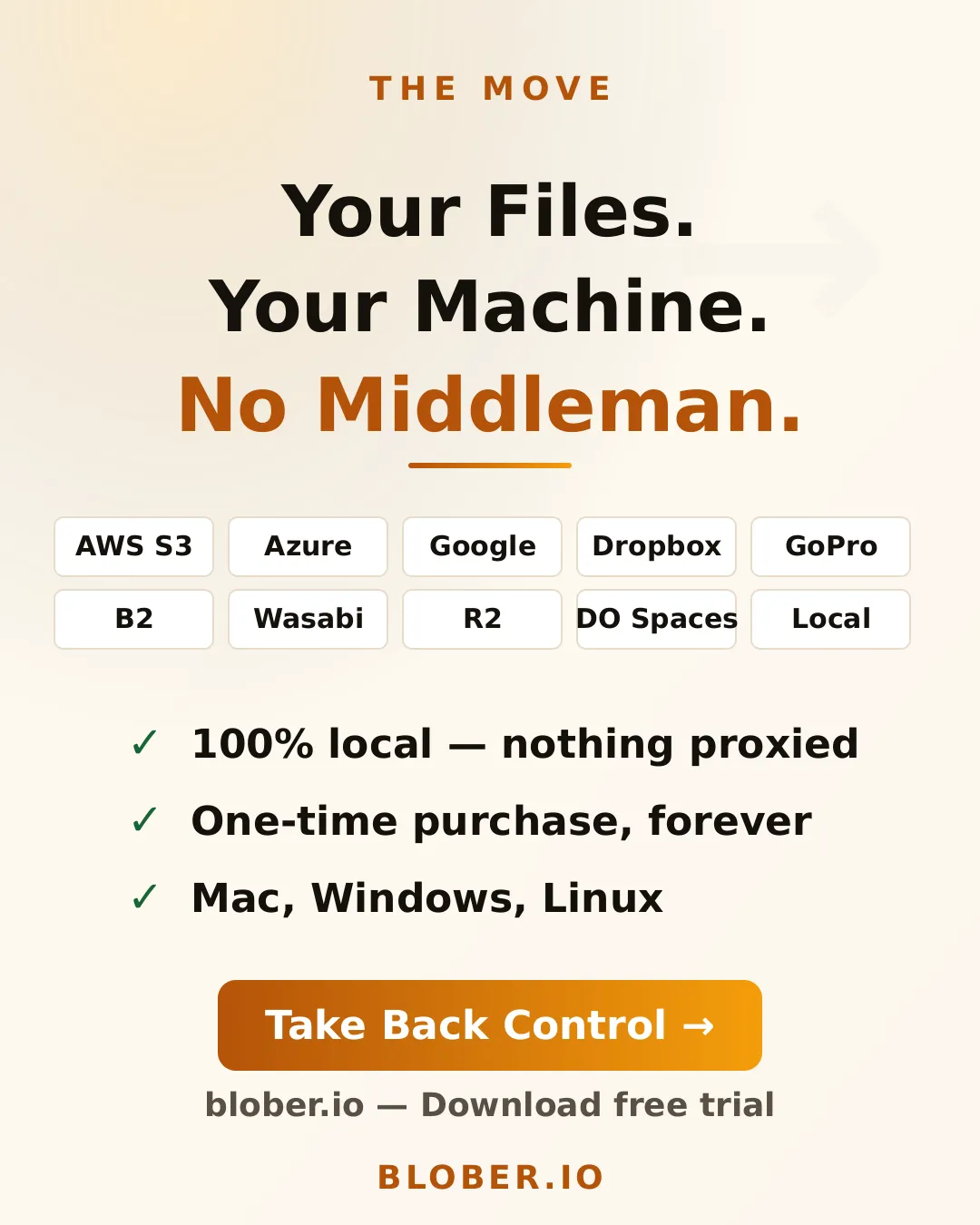
Section titled “1. One Interface for All Your Storage”Blober connects to the storage providers data holders actually use:
| Provider | Typical Use Case |
|---|---|
| AWS S3 | Production infrastructure, enterprise backups |
| Backblaze B2 | Affordable long-term archive |
| Wasabi | Hot storage with no egress fees |
| Cloudflare R2 | CDN-adjacent delivery, zero egress |
| Google Cloud Storage | Workspace-integrated projects |
| Azure Blob Storage | Enterprise and compliance workloads |
| DigitalOcean Spaces | Dev team object storage |
| GoPro Cloud | Action camera footage (Blober exclusive) |
| Dropbox | File sharing and synchronization |
| Local / NAS | On-premise primary storage |
No other single tool covers this range — especially GoPro Cloud, which Blober is the only application to support.
2. Direct Cloud-to-Cloud Transfers
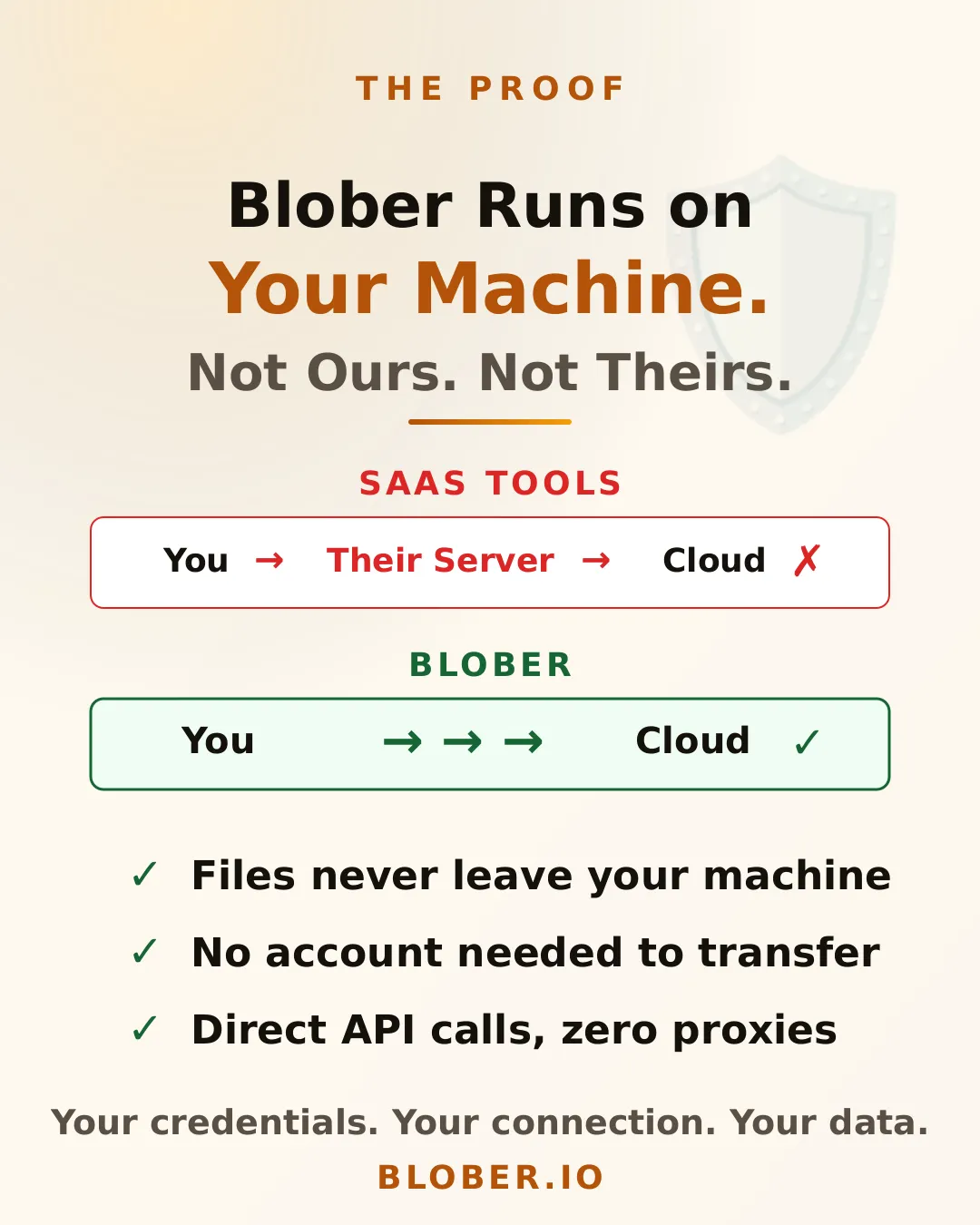
Section titled “2. Direct Cloud-to-Cloud Transfers”Instead of downloading files to your machine and re-uploading them, Blober transfers data directly between providers. This matters for data holders because:
- Saves time — a 2 TB migration doesn’t bottleneck on your home internet
- Saves bandwidth — your ISP data cap stays intact
- Reduces failure points — no half-downloaded files sitting on your local disk
3. Metadata-Driven Organization
Section titled “3. Metadata-Driven Organization”Data holders accumulate files over years. Manually sorting them into folders is unsustainable. Blober supports path templates that use file metadata to auto-organize during transfer:
/{year}/{month}/{camera_model}/{filename}A flat dump of 50,000 files becomes a clean archive:
/2025/06/HERO13 Black/GX015742.MP4/2025/06/Canon EOS R5/IMG_4521.CR3/2026/01/iPhone 15 Pro/IMG_0032.HEICThis works for any transfer — cloud-to-cloud, cloud-to-local, or local-to-cloud.
4. Scheduled and Resumable Transfers
Section titled “4. Scheduled and Resumable Transfers”Backup workflows for data holders need to be reliable, not heroic. Blober supports:
- Resumable transfers — if your connection drops or your machine restarts, pick up where you left off
- Incremental syncs — only transfer files that are new or changed since the last run
- Large-file handling — multi-part uploads for files in the tens of gigabytes
No babysitting required. Set up a transfer, let it run, and come back to a completed job.
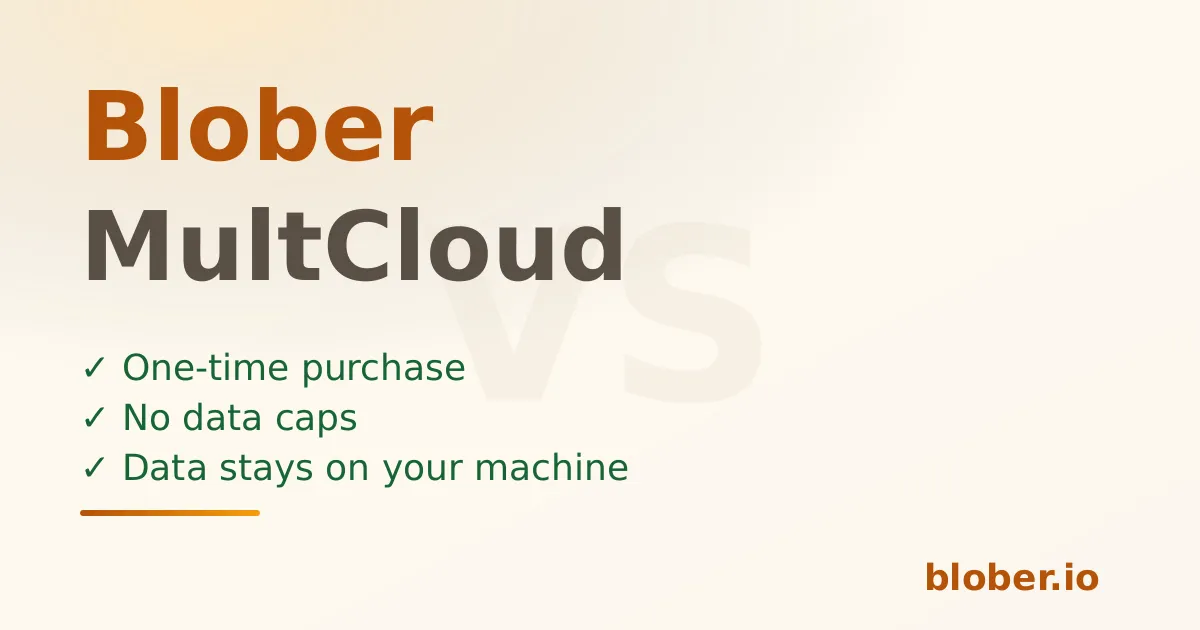
5. One-Time Pricing
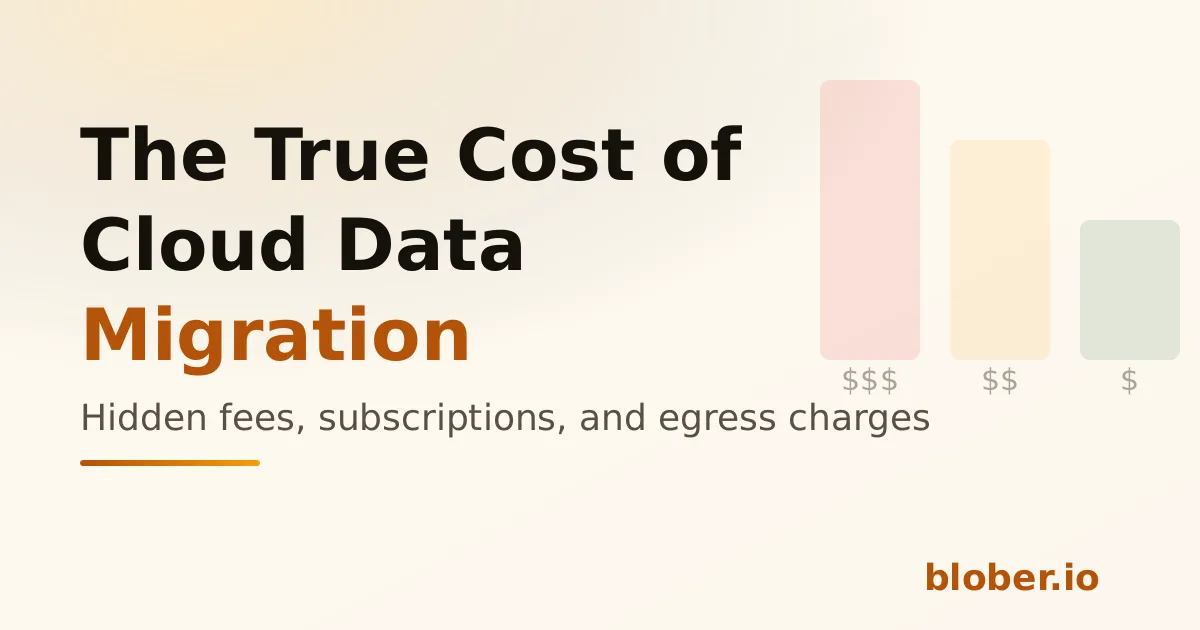
Section titled “5. One-Time Pricing”Most cloud migration tools charge per-GB or require annual subscriptions with data caps. For data holders who move terabytes regularly, those costs compound:
| Tool | Pricing Model | Cost for 10 TB/year |
|---|---|---|
| Flexify.io | ~$0.03/GiB per migration | ~$300+ (plus egress) |
| MultCloud | $99.98/year for 2.4 TB cap | ~$400+ (need multiple renewals) |
| rclone | Free but manual | $0 (but hours of CLI configuration) |
| Blober | One-time purchase | One price, unlimited transfers |
You buy Blober once. Transfer 1 TB or 100 TB — the price doesn’t change.
Real-World Workflows
Section titled “Real-World Workflows”The Freelance Videographer
Section titled “The Freelance Videographer”Setup: 8 TB of footage across GoPro Cloud, a local NAS, and Google Drive. Delivers finals via Dropbox.
With Blober:
- Connects GoPro Cloud and pulls all footage to Backblaze B2 as a cold archive
- Moves finished projects from local NAS to Cloudflare R2 for client delivery
- Uses path templates to organize by project date and camera model
- Runs periodic syncs from Google Drive to B2 to keep a second backup
Result: One tool replaces four manual processes. Total cost: one Blober license.
The Small Business IT Admin
Section titled “The Small Business IT Admin”Setup: 500 GB of compliance documents in Azure Blob Storage. Daily operational files in Google Workspace. Regulatory requirement for off-site backup.
With Blober:
- Transfers compliance archive from Azure to Backblaze B2 as a secondary backup
- Syncs critical Google Drive folders to a local NAS nightly
- Uses Blober’s incremental sync so only changed files move each day
Result: Meets audit requirements for geographic redundancy without provisioning a second enterprise cloud account.
The Research Lab
Section titled “The Research Lab”Setup: 12 TB of experimental datasets in AWS S3. New data generated weekly. Grants require data preservation for 10 years.
With Blober:
- Migrates completed datasets from S3 Standard to Backblaze B2 (80% storage cost reduction)
- Keeps active datasets in S3 for compute-adjacent access
- Uses metadata templates to organize by experiment ID and date
- Resumable transfers handle multi-GB dataset files without corruption
Result: Storage costs drop dramatically while preservation requirements are met.
Why Not Just Use rclone?
Section titled “Why Not Just Use rclone?”rclone is a powerful open-source CLI tool, and many data holders start there. But it has real limitations for ongoing data management:
| Capability | rclone | Blober |
|---|---|---|
| GUI for browsing files | No (CLI only) | Yes |
| GoPro Cloud support | No | Yes (exclusive) |
| Dropbox support | Yes | Yes |
| Visual transfer progress | Limited | Full progress dashboard |
| Resumable multi-part uploads | Partial | Built-in |
| Path template organization | Manual scripting | Visual template builder |
| Error handling and retry | Config flags | Automatic |
| Setup time | Hours (config per remote) | Minutes (OAuth flows) |
rclone is great for scripted, automated pipelines. Blober is built for data holders who want reliable transfers without writing shell scripts.
Getting Started as a Data Holder
Section titled “Getting Started as a Data Holder”- Audit your storage — list every provider and local device where you keep files
- Identify your archive tier — choose an affordable destination like Backblaze B2 or Wasabi for long-term storage
- Connect everything in Blober — add each provider via OAuth or API key
- Set up your first migration — pick a source, pick a destination, configure a path template
- Let Blober handle the rest — resumable transfers, incremental syncs, and metadata organization do the heavy lifting
Your Data, Your Infrastructure
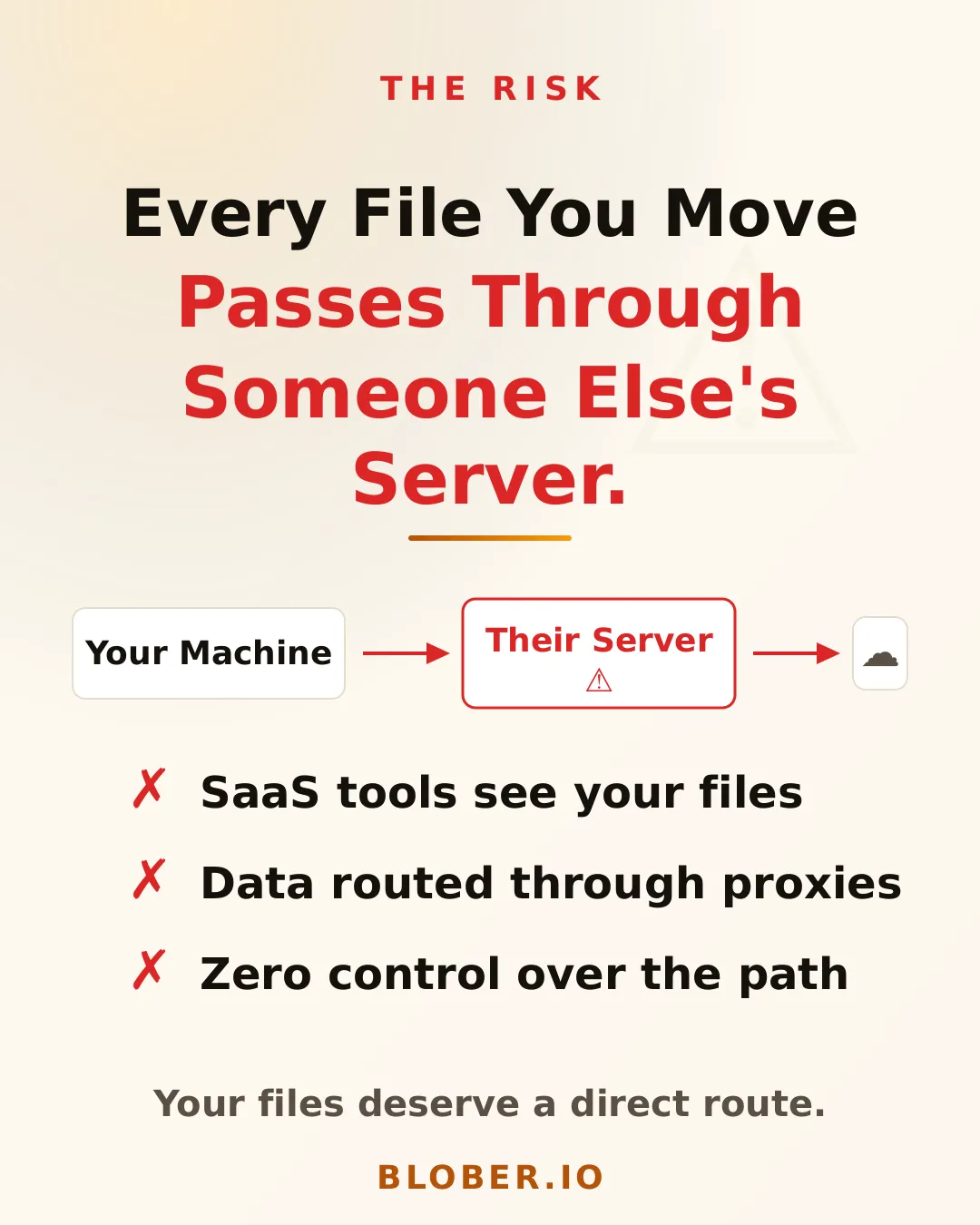
Section titled “Your Data, Your Infrastructure”Data holders shouldn’t need a subscription to manage their own files. Blober runs locally on your machine — your credentials never pass through third-party servers, your transfer bandwidth isn’t metered, and your workflow isn’t gated by monthly caps.
One license. Unlimited providers. Unlimited data.
Get Blober and take control of your data workflow.